The solutions and steps surrounding my plan to limit the removal of books from public school classrooms and libraries is a daunting task. Because the issue is so vast and national, it will take lots of organization and committment. Prior to this moment, the most common actions taken to combat books being banned were Banned Books weeks and challenges to other books to show the hypocracy surrounding banning of books.
Banned Books weeks are where schools would promote books that are banned, encouraged students to read them and also drawing attention to the issue at hand. These are fairly successful during the week but ultimately don’t have a ton of power and can bring backlash of their own from parents. Another course of action that one man took was challenging the Bible as a text that should be in schools. The man, Chaz Stevens has a point. He argues the Bible has many references to rape, bestiality, cannibalism, and discusses homosexuality; all topics that he argues are not age appropriate.1 Some of these topics are reasons books have been banned in the past. His point is not to actually get the book ban but merely to expose the hypocrisy which he hopes will bring public awareness and potential changes to future rulings. Below are certain steps that I propose taking in order to prevent the banning of books and try to undo some of the damage that has occurred.
Public Education campaign
Right now, activists pushing for book bans are incredibly effective at shaping public opinion, mainly through tactics that invoke fear in parents and other concerned citizens. They frame arguments around banning certain books around terms used to scare people like “Critical Race Theory”, or around topics that “may make students uncomfortable” like ones with LGBTQA+ protagonists or ones that reference sexual activity. One reason for the effectiveness is the minimal pushback against these claims or accusations.
What if I told you, as a fact, that banning books detrimentally effected children’s social and emotional development. Or better yet, parents concerned about uncomfortable topics in books found out that were the case. In a study, students were placed into literature circles, small groups of students rather than the whole class, and read and dissected texts. Some texts were marked as controversial and some were not. The study found that “Self-management of emotions, social awareness, social metacognition, appropriate leadership capabilities, and empathy all increased” with literature circles focusing on controversial topics2. Additionally, it has been found that by supporting these students’ emotional and social development, stereotypes can break down, empathy for others increases, and students are more aware of nuances around3. This would create more effective students who can work together, creating a better classroom learning environment, leading to a better experience.
Additionally, banning books is detrimental to teachers creating lessons for students, negatively effecting their education. “When books are banned, unbanned, questioned and concerned, the footing of curriculum becomes shaky and unstable”4 since teachers are unsure what is and isn’t allow and have to constantly reshape curriculum to adapt to changing guidelines. Furthermore, threats of challenges strike fear into teachers resulting in “self-censorship”, as teachers “take it upon themselves to avoid the proverbial guillotine”4. This further neglects children in the classroom as teachers play it safe, using second and even third choice materials to avoid even the slightest complaint.
By utilizing a public education campaign, we will run into a obstacle of the opposing sides attempt to frame the narrative in their favor. While this isn’t easy, the facts to bear lie on our side, and if we will need to reach out and try to touch the same emotions disinformation can bring. If a better experience for their children isn’t enough to sway concerned parents, then unfortunately more drastic steps must take place legally and politically.
Court Challenges
Because the courts have weighed in on this issue, we can utilize them to stop book bans and removals. From Pico v. Board of Education, we know that there is precedent for book removals to not be allowed based up political or moral views. Now this may be challenging to prove but the facts back it up that the vast majority of book bans are centered around political and social issues. The vast majority of book bans involve conversations of “race, racism, sexual orientation, and gender identity”5. These are all very prevalent social and political issues. Additionally, 41% of bans targeted books with prominent characters of color, 22% books explicitly discussing race and racism, 33% books discussing LGBTQA+ or have protagonists identifying as such, and 9% books about rights or activism. These statistics provide substantial proof that the books are being banned more because of the challengers political views than the appropriateness of the content in them.
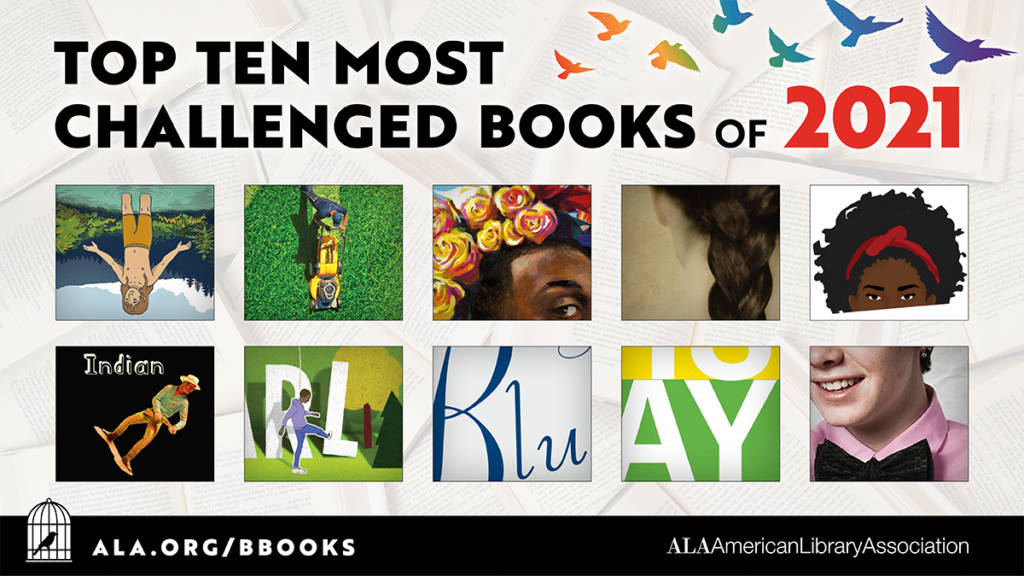
Additionally, this visual shows the ten most challenged books of 2021. While it may be difficult to figure out what some of the books are about, several of them clearly involve non-white characters. Since discussion of race and identity in America has become so politized, this further demonstrates how challenges and bans have become so political, something Pico v. Board of Education was supposed to not allow.
In theory, we could use this as evidence to show that the reason that these books are being removed is not because of appropriateness or vulgar content, but rather because of social or political views of those in power deciding on these issues. There need to be clear guidelines as so what is considered inappropriate for schools without personal agendas playing a role. Additionally, guidelines already in place must be adhered to. Right now, “98% of book bans did not adhere to established guidelines for challenging materials in schools”5 meaning that these actions of removal must be challenged and likely will succeed.
Because a court battle will involve an us against them narrative, we will need to prove to a judge and possibly jury why our case is more valid. Again, the facts remain on our side, and assuming impartiality, we should be able to win legal cases involving book bans and challenges. However, because of how politized some courts have become, particularly the Supreme Court, it may be nearly impossible to win given the predominant judicial philosophy of the court.
Encouraging citizens to run for local elections
The most important thing we can do to change the structures within how curriculum is made is to encourage informed citizens to run for local school board elections. Because the school board has the power to change and alter school curriculum, if sensible individuals hold those posts, students will have better education and be exposed to complex and critical issues discussed in literature and other texts in a multitude of classes. Contrary to the popular belief that “if we hide the truth, then it somehow stops being the truth”, this is not the case at all.6 In fact, censored texts are censored because they most likely portray an accurate and honest account of experiences or events rathe than sugarcoating them.
While educating and encouraging parents on this issue will take time, organization, and patience, it is ultimately the most effective way to tackle this problem and take back power for banned books. Elections are difficult to win, and will take organization to find candidates, campaign staff, events, and most importantly votes, but it is essential that we do the best we can to make sure book ban enthusiasts who are also running for these positions, don’t get to determine curriculum that every student and teacher will be impacted by.
1. Schwartz, Matthew S. (2022). “Florida man asks schools to ban Bible following the state’s efforts to remove books”. NPR. https://www.npr.org/2022/04/26/1094740651/florida-man-asks-schools-to-ban-the-bible-following-the-states-efforts-to-remove
2. Venegas, Elena M. (2019) “‘We listened to each other”: Socioemotional growth in literature circles. The Reading Teacher, 73(2), 149–59.
3. RIVERA, KIMBERLY, and ELLEN FLYNN. “Don’t Avoid Controversial Literature: Your Students’ Psychological Health Depends on It.” Education, vol. 142, no. 3, Spring 2022, pp. 153–56. EBSCOhost, https://search.ebscohost.com/login.aspx?direct=true&db=ehh&AN=155700443&site=ehost-live.
4. Agee, J. (1999). “There it was, that one sex scene”: English teachers on censorship. English Journal, 89(2), 61-69.
5. Kirch, Claire, and Andrew Albanese. “Challenging Book Banning.” Publishers Weekly, vol. 269, no. 16, Apr. 2022, pp. 8–10. EBSCOhost, https://search.ebscohost.com/login.aspx?direct=true&db=ehh&AN=156370866&site=ehost-live.
6. Palmer, Megan. “Book Banning Bans the Future: The Negative Effects of Book Banning Regarding High School Students .” Core, 31 Dec. 2014, https://core.ac.uk/download/71369344.pdf.